AI product photography vs a real shoot: cost and timeline
Short answer
A studio-made AI product set usually costs a fraction of a one-day real shoot and arrives in days rather than weeks, but pure AI struggles with exact product geometry, labels and materials. For most brands the right answer is a hybrid: photograph the product once as clean plates, generate the environments around it, and composite. You get the fidelity of a shoot and the variety of AI.
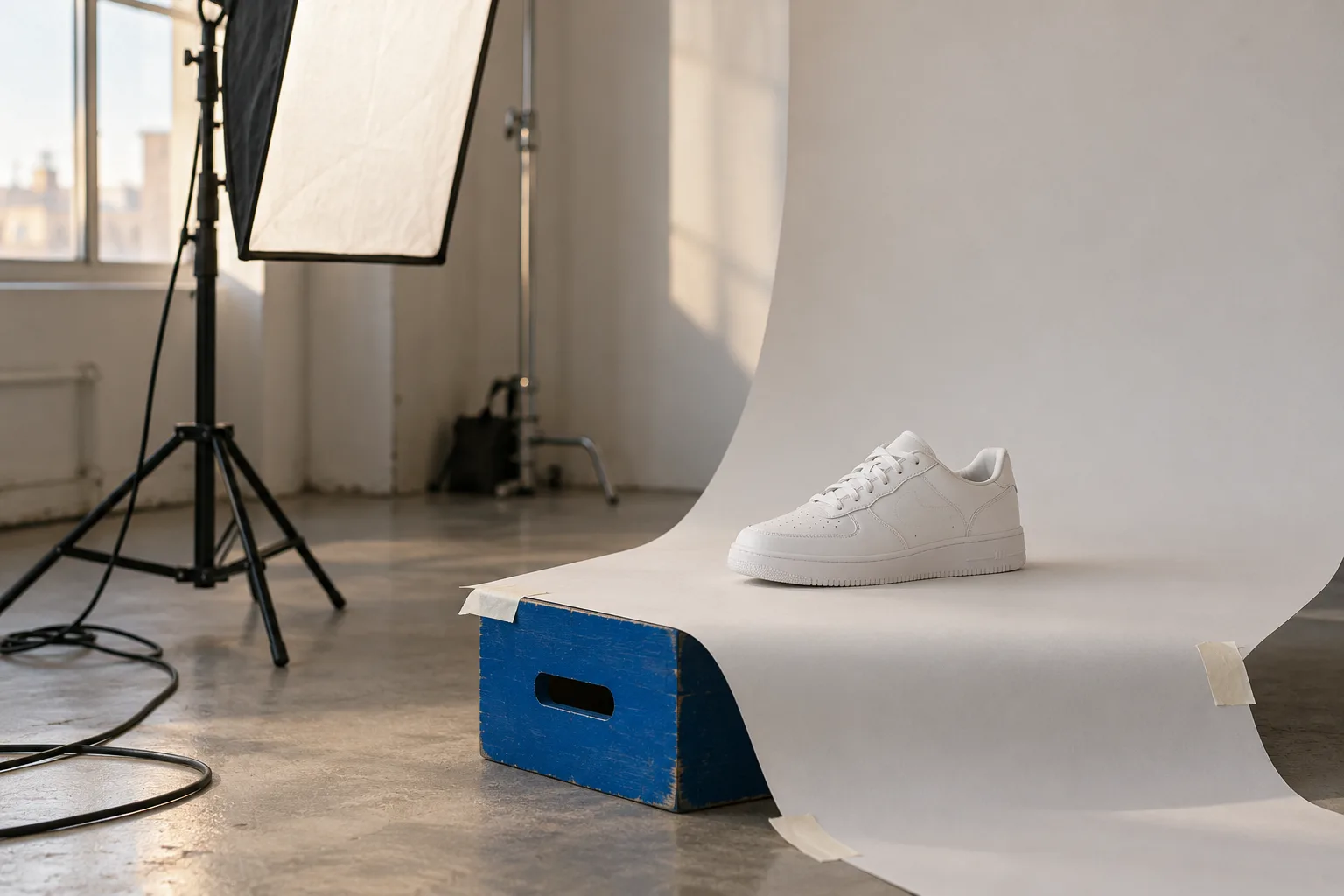
A white sneaker arrived in a box on a Tuesday. The brand wanted forty finished images across six settings by the following Thursday: a studio packshot, a running track at dawn, a concrete stairwell, a wet pavement, a locker room, a flat lay for the newsletter.
Ten years ago that call sheet is three locations, a van, a stylist and two long days. We put the shoe on a sweep for ninety minutes, shot twelve angles under one light, and generated everything else around it.
That job is the whole argument of this post. Not AI instead of a shoot. A small shoot, then AI.
How much does AI product photography cost?
A studio-made AI product set in 2026 typically lands between about €1,500 and €6,000 for twenty to forty finished images, depending on how many settings you want and how exact the product has to be. Self-serve tools cost €20 to €100 a month but move the direction and quality control onto your own desk. A one-day real shoot with a photographer, studio and retouching usually starts around €2,500 and climbs past €15,000 once styling, talent and locations are involved.
Those ranges hide the real variable, which is fidelity. A soft, rounded product in a lifestyle setting is cheap to get right with AI. A bottle with a printed label, a watch face, or a shoe with visible stitching is expensive to get right, because every frame has to be checked against the physical object and most of them fail.
The other thing the ranges hide is reshoots. On a real shoot a missed angle means rebooking the studio. On an AI set a missed angle is another round of takes, which is hours rather than days.
What does a real product shoot cost and how long does it take?
A real product shoot is priced by the day and by the people in the room. In our experience a photographer's day rate, a studio, a stylist or set builder, and retouching at a per-image rate add up to roughly €2,500 to €6,000 for a simple tabletop day and €8,000 to €15,000 or more once there is a location, talent or a set build.
Lead time is the part people underestimate. Samples have to reach the studio, the photographer has to be available, the stylist has to source props, and retouching takes a week after the shoot. Two to four weeks from booking to final files is normal.
What you get for that is unarguable product truth. The shoe is the shoe. The label is legible at 200 percent zoom. The leather grain is real leather grain. Nobody has to check a frame against the physical object because the frame is the physical object.
Real shoot vs AI vs hybrid: the honest comparison
Here is how the three options compare on the things a brand actually asks us about. The ranges are from our own quotes and from what clients tell us they have paid elsewhere, so treat them as a map rather than a price list.
| Real shoot | Pure AI | Hybrid (plates + AI) | |
|---|---|---|---|
| Typical cost, 20–40 images | €2,500–€15,000+ | €1,500–€6,000 | €2,500–€8,000 |
| Lead time | 2–4 weeks | 5–10 working days | 7–12 working days |
| Reshoots | Rebook studio, days to weeks | Hours, included in rounds | Hours for scenes, a day if a plate is missing |
| Consistency across a set | High within one day's light | Medium; drifts across scenes | High; the same plate in every scene |
| Product fidelity | Exact | Approximate; labels and geometry drift | Exact product, generated world |
| Number of settings | Limited by budget and travel | Effectively unlimited | Effectively unlimited |
| Wins when | Product is the hero at large size; glass, jewellery, food | Mood, context, concepting, social volume | Ecommerce plus lifestyle from one brief |
The row I would point to is consistency. People assume AI is the inconsistent one, and across scenes it is. But a real shoot across two days, two locations and a changing sky is also inconsistent, and nobody says so because the product is at least correct in every frame.
Where does AI product photography fall down?
Pure AI product photography fails at the small, specific truths a customer checks before buying: label text, logo placement, the number of stitches on a seam, the thread on a cap, the exact proportion of a bottle neck to its body. It also drifts on colour, so a brand red comes back slightly orange in one frame and slightly pink in the next.
The failure that costs the most is the one nobody catches. The bottle looks right from across the room. A product manager sees it at phone size and approves it. Then a customer receives the real thing and the shoulders of the bottle are a different shape. That is a returns problem, and in some categories a legal one.
Reflections are the second tell. A glossy product in a generated scene reflects a world that does not match the one it is standing in. Glass and chrome are the worst for this, and the fix is almost always a real plate.
Then there is the client's own eye. A founder who has held the product for three years will see a wrong curve in a tenth of a second. We have learned to show that person the first generated frames before anyone else, because they are the fastest QC pass available.
Why is hybrid usually the answer?
Hybrid means photographing the real product once, cleanly, from eight to twelve angles under controlled light, then generating the environments and compositing the real product into them. You pay for a short shoot and a set of AI scenes, and you get a product that is correct in every frame with a world around it that can be anything.
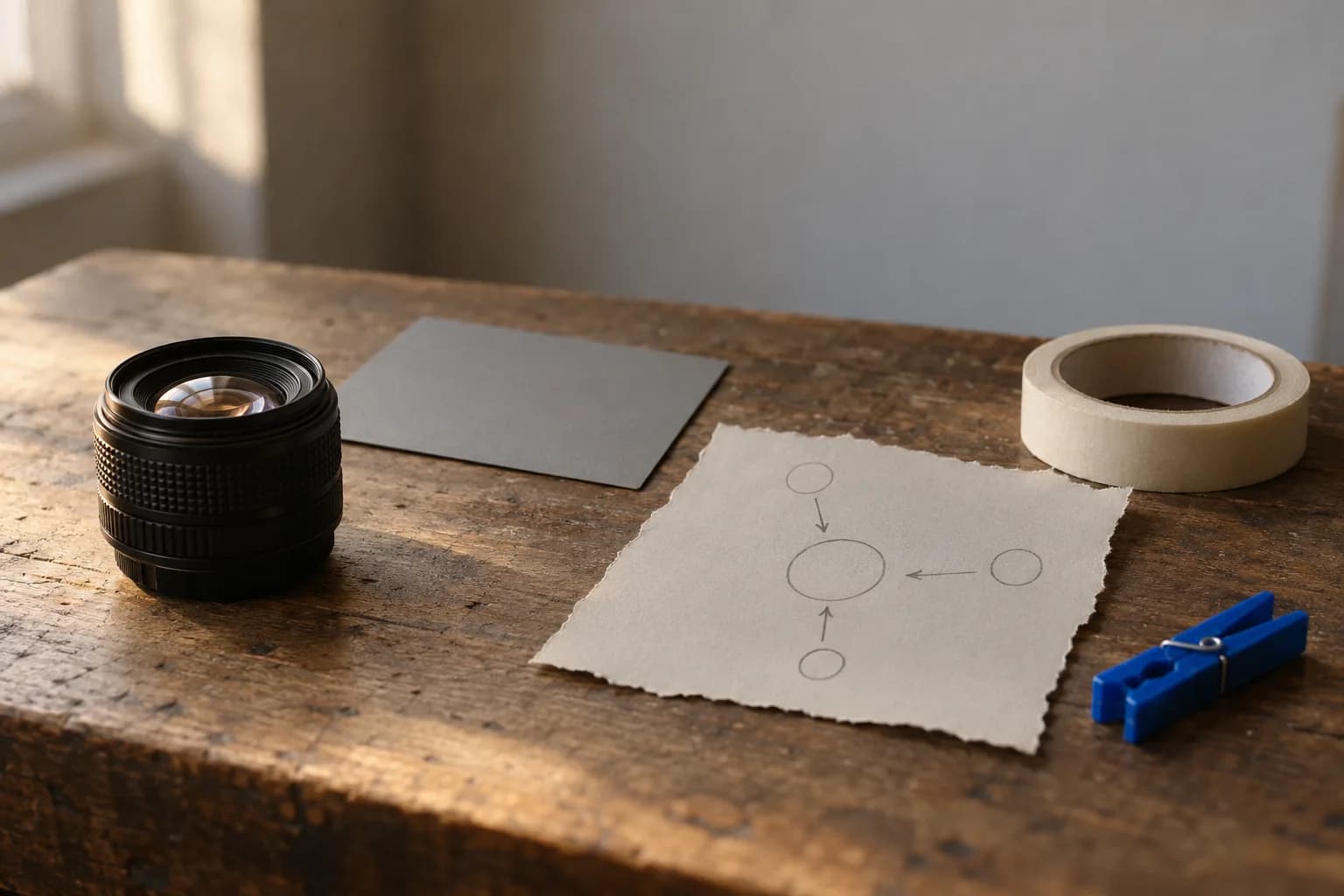
In practice the plate shoot is a half day. One sweep, one or two lights, a grey card, a turntable if the product has a shape that matters. We shoot more angles than the brief needs because the angle you did not shoot is the one the marketing lead asks for a week later.
The generated side then has one job: build a believable world around a fixed object. Match the light direction to the plate, match the perspective, add the shadow and the contact point, grade everything to one look. That is far easier than asking a model to invent a correct product and a correct world at the same time.
Shoot the thing that has to be true. Generate the things that only have to be believable.
Hybrid also solves the consistency problem across forty images. The same plate goes into every scene, so the product is identical on the locker room floor and the wet pavement. I wrote more about how that process works in the consistency post.
When should you just book a real shoot?
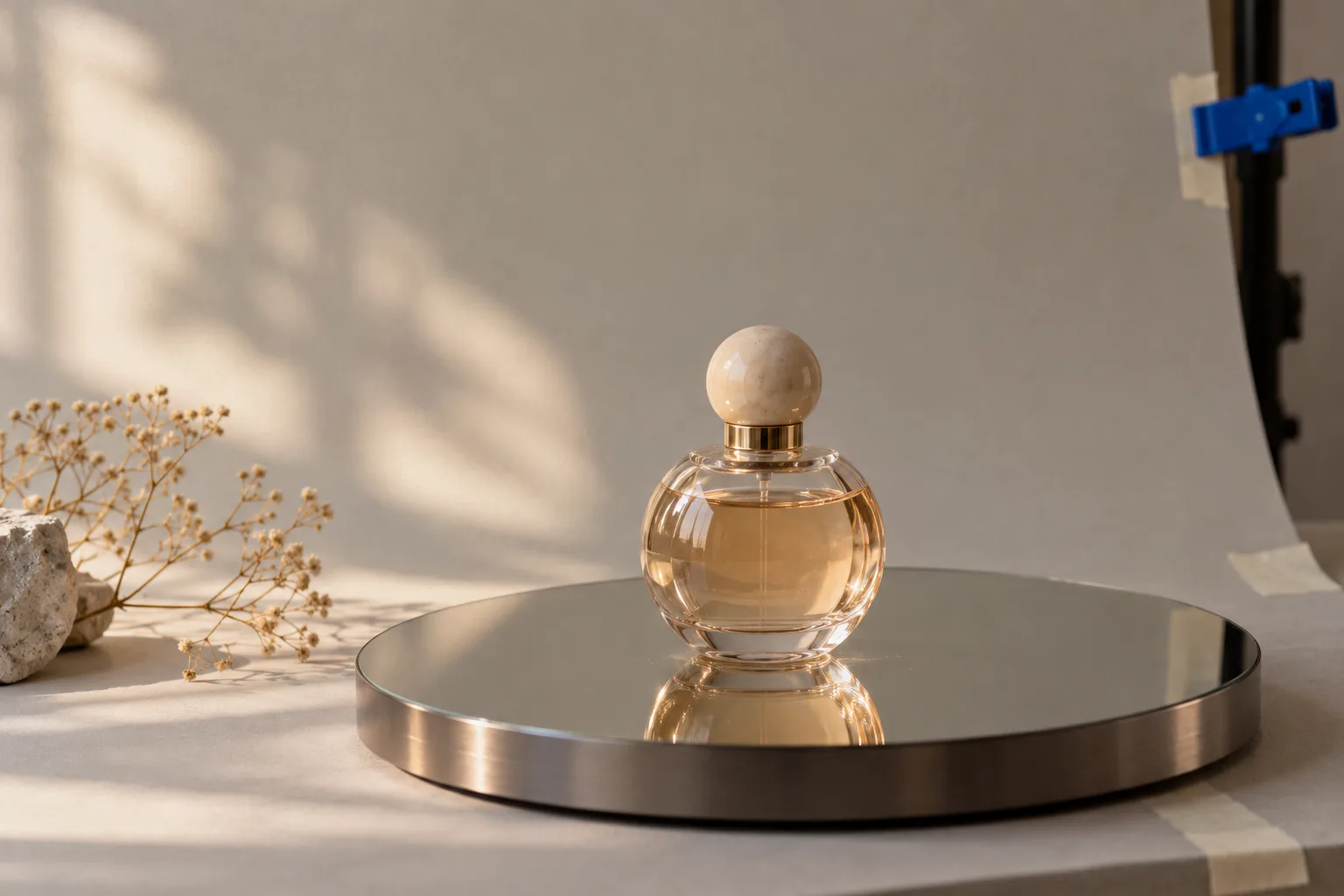
Book a real shoot when the product itself is the picture: jewellery, cut glass, perfume bottles with complex refraction, watch faces, food that has to look edible, fabric where the drape and weave are the selling point. Book one when the image will be printed at two metres wide, or when the product must appear in a real person's hand to support a claim.
There is also a category of brands for whom a real shoot is a statement. If your positioning is handmade, analogue, or anti-AI, a generated image contradicts the brand even when nobody can tell. That is a judgement, not a technical limit, and I would rather you make it on purpose.
When is pure AI fine?
Pure AI is fine when the product is simple in shape, when the image is about context rather than detail, and when the volume matters more than any single frame: social backgrounds, mood boards, seasonal variants, newsletter headers, A/B tests where you want twelve settings by Friday. Soft goods, candles, boxes and simple packaging usually survive it well.
It is also fine as a first draft. We often generate a full set of scenes before the plate shoot so the client can approve directions, then replace the generated product with the real one. The AI version is the storyboard, not the deliverable.
Where I would not use pure AI is anywhere a customer zooms in, or anywhere a regulator might. See the disclosure post for the second half of that sentence.
What I'd tell you on a 15-minute call
Send me the product, the number of settings you need, and one example image you love. From that I can tell you in a few minutes whether it is a pure AI job, a hybrid, or a shoot you should book with a photographer instead of us.
If you want the longer version of how we price this kind of work, including what makes a quote go up or down, it is in what AI video costs in 2026. The same logic applies to stills. And the hybrid sets we have made are on the front page, where you can zoom in and judge the labels yourself.
Frequently asked
Is AI product photography good enough for an ecommerce product page?
For lifestyle and context images, usually yes. For the main packshot that a customer zooms into, I would still photograph the real product, because labels, seams, threads and exact proportions are where generated images drift. A hybrid gives you both from one small shoot.
How long does AI product photography take compared with a real shoot?
A real shoot is typically two to four weeks from booking to retouched files once you count scheduling, samples, the shoot day and retouching. A studio-made AI set is usually five to ten working days from brief to delivery, and a hybrid sits in between because the product plates still need to be photographed.
Can I just use an AI tool myself instead of hiring anyone?
You can, and for backgrounds and mood boards it works. The cost that moves from the invoice to your calendar is direction and quality control: picking the two usable images out of forty, checking the product against the real thing, and fixing what is wrong. If you have that time and eye in-house, do it.
Got a product and a deadline? Fifteen minutes is usually enough to tell you whether AI is the right way to make it, and what it would cost.
Book a callor look at the work